

Volleyball Rotations and Positions Explained for Beginners
Volleyball can look chaotic if you are new to it: players sprinting across the court between points, hands signaling behind their backs, and constant talk about "rotations," "setters," and "liberos." Underneath that movement is a very specific structure. Understanding rotations and positions is one of the fastest ways for beginners to enjoy playing, follow matches more easily, and develop real game sense.
This sports guide walks through where everyone stands, why they move, and how modern systems work in both recreational and competitive play.
The basic layout of a volleyball court
At its core, volleyball uses a 6-on-6 format indoors. The court is divided into a front row and a back row by the attack line (also called the 3-meter or 10-foot line). At any moment, each team has three front-row players and three back-row players.
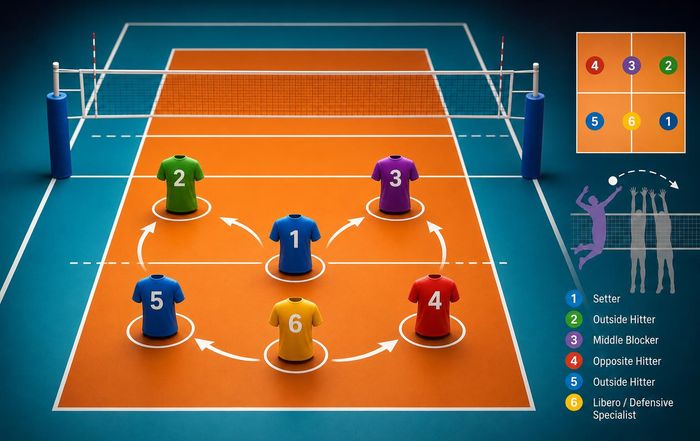
The six rotational spots are numbered and always follow the same clockwise order:
Position 1: right back (RB) - usually the serving position
Position 2: right front (RF)
Position 3: middle front (MF)
Position 4: left front (LF)
Position 5: left back (LB)
Position 6: middle back (MB)
Imagine looking at your own team from behind the baseline: Position 1 is back-right, then it circles around the court. These numbers describe rotational spots, not permanent "jobs." A player might be the team's setter, but they will still rotate through all six numbered locations during the match.
For a visual sense of the court and official dimensions, the rules from USA Volleyball and the global governing body FIVB are useful references. At a recreational level, many leagues follow similar layouts, even if they adjust scoring or net height.
If you are just starting out and want to pair rules knowledge with conditioning, it can help to mix basic court understanding with general fitness and movement training, so shuffling, jumping, and quick changes of direction become more natural.
Rotations: why players keep moving
The rotation system exists to keep play fair and prevent one dominant player from simply camping in the best attacking spot all match. Every time your team wins the right to serve after receiving (a "side-out"), your players rotate one position clockwise. The player in Position 2 moves to Position 1 to serve, Position 1 moves to Position 6, and so on around the circle.
There are two overlapping ideas beginners need to separate:
Rotational order (positions 1-6). This is the fixed order in which players must serve and line up before each rally. You are not allowed to skip or rearrange that order without a substitution. Being "out of rotation" is a fault and costs a point.
Playing roles (setter, outside hitter, etc.). These are tactical jobs. Teams design serve-receive patterns and defensive systems so that, once the ball is in play, players quickly move into their preferred roles while still respecting rotational rules.
Before each serve, players must stand in correct rotational order relative to teammates. Once the server contacts the ball, they can move into their specialized spots. This is why you see players crisscrossing right after the serve: they are transitioning from mandatory rotational positions into their tactical formation.
Competitive coaches often use court diagrams and hand signals to teach these movements. For beginners, a simpler approach-like always pulling the setter to the right front or right back after serve-is usually enough. Over time, understanding rotations becomes as automatic as knowing where to run in a pick-and-roll in basketball or where to line up in soccer.
Positional roles: who does what on the court
Although everyone rotates, modern volleyball is highly specialized. Most teams use a structure where players focus on a primary role that fits their height, jumping ability, ball control, and decision-making.
Setter
The setter is the tactical organizer, often compared to a quarterback or point guard. Their main job is to take the second ball and "set" it to a hitter with a clean, well-timed touch. The setter decides which attacker to use, how fast the ball should travel, and how to exploit the opposing block.
In many systems, there is one primary setter who plays all the way around (a "5-1" system). In others, two setters share the role, each setting only from the back row (a "6-2" system). We will break those systems down later, but for beginners, the key idea is simple: the setter wants to touch the second ball whenever possible and deliver it to a teammate in a strong attacking position.
Outside hitter (left-side)
The outside hitter (or left-side hitter) often receives serve, plays strong defense, and is a primary attacker. Because they hit from the left side (Position 4 in the front row, Position 5 in the back row), they frequently receive high sets that allow time to adjust to imperfect passes. This makes them a "go-to" option when the team is in trouble.
At many beginner and school levels, the outside hitter also serves as a team leader in communication and energy. They must balance offense, defense, and serve-receive, so they benefit from strong all-around training and conditioning.
Opposite hitter (right-side)
The opposite hitter, also called the right-side hitter, plays opposite the setter in the rotation-when the setter is in Position 1, the opposite is usually in Position 4, and so on. This player typically attacks from the right front (Position 2) and blocks the opponent's outside hitter, who is often their strongest attacker.
Because the opposite is frequently not involved in serve-receive, they can focus more on attacking and blocking. Left-handed players often thrive here, as hitting from the right side naturally suits their swing angle, but right-handed players are more common overall.
Middle blocker / middle hitter
The middle blocker patrols the center of the net, trying to stop or slow the opponent's attacks. They read the opponent's setter, move laterally to form double blocks, and must react quickly. On offense, they hit fast sets near the setter, often called "quick sets" or "1s" and "3s," which aim to beat the block with speed.
Because middle blockers spend so much time at the net, they often specialize in explosive jumping and lateral movement. At higher levels, they are frequently subbed out in the back row for a defensive specialist or libero to keep the team's performance and ball control high.
Libero
The libero is a back-row defensive specialist wearing a different colored jersey. Introduced internationally in the late 1990s, the libero cannot attack above the net height, cannot block, and has restrictions on setting from in front of the attack line. In return, they enjoy more flexible substitution rules, allowing them to replace any back-row player without using a formal substitution.
The libero's core responsibilities are passing serve, digging hard-driven attacks, and stabilizing the team's first contact. For many developing players, libero is a good fit if they are quick, agile, and strong in ball control but not as tall as front-row attackers. Official guidelines from bodies like World ParaVolley and NCAA also adapt the libero role for different formats and levels of the game.
Defensive specialist and serving specialist
Beyond the six main roles, teams sometimes use defensive specialists who substitute into the back row for weaker defenders, and serving specialists who enter specifically to deliver a tough serve. These roles are more common in advanced leagues with larger rosters and formal substitution limits.
At beginner level, most players will play all six rotations and share responsibilities, but understanding what each specialized role does helps new athletes see where they might fit as they progress.
Rotational systems: 4-2, 6-2, and 5-1 explained
For new players, the numbers in system names (4-2, 6-2, 5-1) can be confusing. They simply describe how many hitters and setters are on the court in the front row at a time.
4-2 system: simplest for beginners
A 4-2 system uses two setters and four hitters. Only the setter who is currently in the front row sets; the back-row setter becomes a hitter or defensive player. Because the setter is always near the net when they set, the offense is easy to organize.
For youth teams, school programs, and casual leagues, the 4-2 is often the first system taught. It keeps rotations straightforward: when you are front row, you set; when you are back row, you hit or defend. The downside is that you usually have only two front-row hitters available, which can make it easier for opponents to block.
6-2 system: more offense from the back row
In a 6-2 system, there are two setters, but they only set when they are in the back row. When a setter rotates to the front row, they become a hitter, and the other setter-now in the back row-takes over setting duties. This means you always have three front-row hitters available, which increases attacking options.
The "6" refers to six potential hitters (everyone except the libero), and the "2" refers to the two players who act as setters when they are in the back row. This system can generate a lot of offense but requires more complex rotation patterns and clear communication. It is common in high school and club volleyball, particularly when a team has two players with strong setting skills.
5-1 system: one setter runs the show
The 5-1 system features one setter who plays all the way around and five primary attackers. When the setter is in the front row, there are two other front-row hitters. When the setter is in the back row, there are three front-row hitters.
This system gives the team a consistent decision-maker and rhythm. Hitters always know who is setting, and the setter can develop chemistry with each attacker. Nearly all professional and high-level collegiate teams use some variation of the 5-1. For learners, it introduces more complex rotations, but it also mirrors how the sport is played at elite levels covered by outlets like Olympics.com and BBC Sport.
Overlap rules: how to stay in legal rotation
One of the most confusing parts of volleyball for beginners is the concept of being "out of rotation" or "overlapping." The rules do not force players to stand exactly on their numbered spots, but they must maintain relative positions compared to certain teammates at the moment of serve.
The key ideas:
Each player has two neighbors in the same row (front or back) and one player directly in front of or behind them.
Before the serve, you must not be closer to the net than a teammate who is supposed to be in front of you.
You must not be closer to the sideline than a teammate who is supposed to be outside you.
For example, if you are in Position 2 (right front), you must be closer to the right sideline than Position 3 (middle front) and closer to the net than Position 1 (right back). Once the server contacts the ball, you can move anywhere on the court.
At beginner levels, referees may be lenient, but in organized competition, being out of rotation leads to a point and serve for the opponent. Understanding these rules is important if you want to play in more structured leagues, such as those affiliated with Volleyball England or Volleyball Canada.
Coaches often use simple cues-like "front row, toes on the attack line" or "back row, heels behind the line"-to help new players visualize legal starting positions. As you gain experience, you can use more advanced formations that still respect overlap rules but place passers and attackers in their ideal spots.
Serve-receive formations for beginners
Serve-receive (also called "passing formation") is where rotations and positions become very practical. The goal is to arrange your players so that your best passers handle most of the serves while still keeping everyone in legal rotation.
Common beginner formations include:
W formation: Three players in a shallow "W" shape across the back half of the court. Simple and used often in youth volleyball.
3-person receive: At more advanced levels, three strong passers-typically the two outside hitters and the libero-cover most of the court, while weaker passers are moved up to the net or to the corners to avoid receiving serve.
Stacking: To keep a strong hitter in their favorite attacking lane, teams sometimes "stack" players close together before the serve, then quickly spread out after contact. This is legal as long as overlap rules are respected.
For new players, it is often enough to remember that back-row players usually handle serve-receive, while front-row players get ready to attack. Over time, learning how to adjust your formation to target or protect certain players becomes a key strategic skill, much like adjusting a defensive scheme in other sports.
Readers interested in how tactics like serve-receive connect to broader sports strategy and in-game decision-making may also enjoy exploring how different national teams and professional clubs adapt these formations based on their personnel.
Defense and transition: rotations once the rally starts
Once the ball is served and your team has passed and set it, rotations give way to defensive and transition systems. These are patterns that tell each player where to move as the rally develops.
Common ideas include:
Base defense: After your team attacks, each player moves to a "base" defensive position suited to their role. For example, the libero often drops to middle back (Position 6), while outside hitters cover line or crosscourt angles.
Perimeter vs. rotational defense: Some teams place defenders nearer to the sidelines (perimeter) to dig hard angles, while others "rotate" defenders to cover tips and roll shots in the middle. Beginners typically start with a simple perimeter-style defense and add rotations as they grow comfortable.
Blocking assignments: Front-row players must know whether they are responsible for single blocking quick middle attacks or moving to form double blocks on the outside. Clear blocking calls-line, cross, or commit-help organize this.
Transition is the phase where your team moves from defense back into offense. Good teams transition quickly: after digging a ball, players instantly find their roles again. The setter sprints to their setting spot, hitters get wide and approach the net, and the libero adjusts to cover tips and off-speed shots.
This constant movement is one reason volleyball is such an effective full-body workout. Integrating court-specific movement into your fitness and health routine can improve not just your game but also your overall agility and cardiovascular conditioning.
Common beginner mistakes with rotations and positions
Learning rotations and positions involves a lot of moving parts, so mistakes are normal. Some of the most frequent issues beginners run into include:
Chasing the ball out of position. New players often follow the ball instead of trusting their assigned zone. This leaves parts of the court uncovered. A simple rule is "do your job, not everyone's job."
Forgetting who is front row vs. back row. Back-row players cannot attack from in front of the attack line if they contact the ball above the net. They also cannot participate in blocking. Knowing whether you are front row or back row in each rotation helps avoid illegal attacks.
Not identifying the setter early. If teammates do not know who is supposed to set, multiple players may crowd the second ball, causing confusion or misplays. Calling "setter out" if the setter digs the first ball is a basic communication tool.
Slow movement after the serve. Players sometimes start in the correct rotational spots but fail to move quickly into their tactical roles once the ball is served. Practicing serve-receive patterns at low intensity can help make those transitions automatic.
Overcomplicating systems too early. Recreational and school teams occasionally copy professional systems they see on ESPN or Sky Sports without having the passing consistency or experience to support them. Simpler is often better until the fundamentals are consistent.
Coaches and players can reduce these problems by walking through rotations slowly, using floor markers or cones, and reinforcing verbal cues. Combining court walkthroughs with targeted training sessions-such as footwork drills, passing reps, and communication exercises-builds confidence in real matches.
How beach and sitting volleyball differ in rotations
While this guide focuses on indoor 6-on-6 volleyball, many athletes also play beach or sitting volleyball. Both share core skills with indoor play but differ in how rotations and positions work.
In beach volleyball, teams usually play 2-on-2. There is no formal rotation order beyond serving alternation, and both players typically share all roles: serving, passing, setting, attacking, blocking, and defending. Because there are only two players, communication and conditioning are crucial. Organizations like AVP and World ParaVolley showcase how elite athletes adapt indoor fundamentals to sand and adaptive formats.
In sitting volleyball, played by athletes with physical impairments, the court and net are lower, and players must maintain contact between their pelvis and the floor when playing the ball. Rotations still exist, but movement patterns are adapted for seated play. The strategic concepts-serve-receive, setting, attacking lanes-remain surprisingly similar, underscoring how fundamental rotations and positions are across volleyball's variations.
For those active people interested in the broader culture and inclusivity of the sport, adaptive formats also intersect with themes covered in culture and world sport development.
Practical tips to learn rotations faster
For beginners looking to feel comfortable on court more quickly, a few practical approaches can make a big difference:
First, treat each rotation as a distinct "scene" and learn them one at a time. Instead of trying to memorize all six at once, focus on what you do when you are in Position 1, then Position 2, and so on. Ask simple questions: Am I front row or back row? Am I primarily passing, setting, or preparing to attack? Sketching these rotations or using court diagrams can help visual learners.
Second, use consistent language. Many teams assign short names to rotations such as "setter front-right" or "setter back-row middle" so players can quickly recall where to stand and where to move. This also helps when coaches are giving instructions during time-outs or between sets.
Third, combine mental rehearsal with physical reps. Walking through rotations slowly-without a ball at first-allows players to feel where they should go. Then, adding live serves and free-ball situations reinforces those patterns under mild pressure. Over time, you can increase the speed and complexity of drills to mimic real game situations.
Fourth, watch volleyball with purpose. Rather than just following the ball in professional or collegiate matches, occasionally focus on a single player-such as the setter or libero-and watch how they move through each rotation. Platforms like YouTube host countless match replays and coaching breakdowns from different countries and playing levels, which can be valuable learning tools.
Finally, remember that volleyball is a team sport where communication is as important as physical skill. Calling out "front row," "back row," "I've got short," or "setter out" keeps everyone aligned. Integrating communication habits into your overall lifestyle as an athlete-such as leadership, clarity, and mutual support-can carry over into other sports and daily life.
Understanding volleyball rotations and positions turns what can look chaotic into something structured and strategic. Once you know where you should be and why, the game opens up: you can anticipate plays, support teammates more effectively, and enjoy rallies instead of just reacting. From casual gym leagues to more competitive environments, mastering these basics is the foundation for everything else you will learn in the sport.