

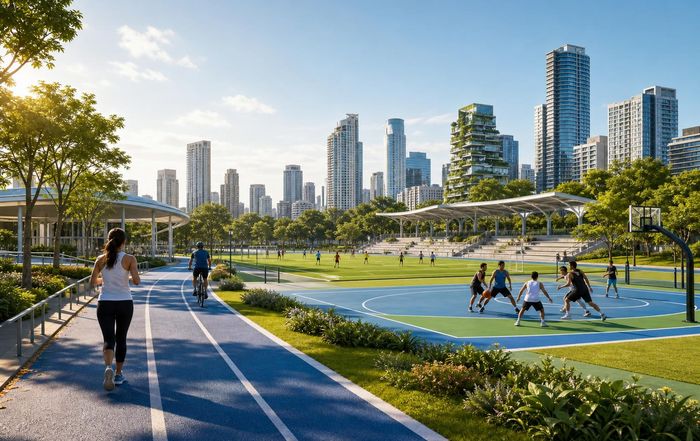
Creating Healthier Cities Through Sports Infrastructure
SportyFusion's Lens on the Urban Health Revolution
Boom! the relationship between cities and their citizens' health is being redefined, and nowhere is this more visible than in the rise of sports infrastructure as a strategic pillar of urban planning. From community pitches in London and rooftop courts in Singapore to cycling superhighways in Paris and multi-sport riverfronts in Seoul, mayors, planners, and business leaders increasingly recognise that physical activity is not a leisure afterthought but a core driver of public health, economic resilience, and social cohesion. For booming sports, active community coming to SportyFusion, which rises at the intersection of sports, fitness, health, and culture, this shift is not a distant policy debate; it is the lived reality of communities, brands, athletes, and innovators who understand that healthier cities are built, quite literally, one pitch, track, and trail at a time.
As global organisations such as the World Health Organization highlight that insufficient physical activity remains one of the leading risk factors for mortality, urban decision-makers are under pressure to move beyond awareness campaigns and into structural solutions that make active living the default rather than the exception. Learn more about global physical activity guidelines from the World Health Organization. The cities that succeed over the next decade will be those that embed sports infrastructure into transport systems, housing policy, environmental strategies, and digital innovation, turning the urban environment into a living, breathing ecosystem for movement.
Why Sports Infrastructure Is Now a Strategic Urban Asset
Sports infrastructure, once primarily associated with elite stadiums and professional clubs, has evolved into a comprehensive urban asset category that ranges from neighbourhood courts and school facilities to greenways, bike lanes, and digitally enabled fitness hubs. This broader definition aligns with research from organisations such as the World Bank, which increasingly emphasises the social and economic value of inclusive public spaces in urban development. Explore how public space investment contributes to urban wellbeing through the World Bank's urban development insights.
For business leaders and policymakers, the strategic case is compelling. Well-designed sports infrastructure reduces long-term healthcare costs by encouraging preventive health behaviours, supports workforce productivity by improving physical and mental wellbeing, and enhances a city's brand as a desirable place to live, work, and invest. The OECD has documented the economic burden of non-communicable diseases and the potential savings from promoting active lifestyles, underscoring that investments in physical activity infrastructure should be viewed as economic policy as much as health policy. Learn more about the economics of health and physical activity through the OECD's health policy resources.
In this context, SportyFusion engages its audience not only as spectators or consumers but as participants in a global shift, where urban sports ecosystems become a competitive advantage for cities across North America, Europe, Asia, Africa, and South America.
Global Trends Redefining Urban Sports Ecosystems
Across continents, converging trends are reshaping how sports infrastructure is conceived, financed, and used. In the United States, cities such as New York and Chicago are repurposing underutilised spaces-rooftops, schoolyards, and vacant lots-into multi-sport community hubs, often in partnership with private sponsors and non-profits. In the United Kingdom, the legacy of major events has spurred long-term investment in community sports facilities, with organisations like Sport England providing strategic frameworks and funding to local authorities. Learn more about community sport investment through Sport England's strategy resources.
In Germany, France, and the Netherlands, integrated cycling and walking infrastructure is now central to city planning, blurring the lines between transport and sport, and creating daily opportunities for movement that are embedded in commuting and leisure. The European Commission has supported these efforts through initiatives promoting active mobility and sustainable urban transport, illustrating how sports infrastructure aligns with broader environmental and climate objectives. Explore European active mobility initiatives via the European Commission's transport policy pages.
In Asia, cities such as Singapore, Tokyo, Seoul, and Bangkok are pioneering vertical and high-density solutions, including elevated running tracks, rooftop football pitches, and mixed-use developments where residential, retail, and sports facilities coexist in walkable precincts. These models are particularly relevant for rapidly growing cities in China, India, and Southeast Asia, where land constraints require innovative design. The United Nations Human Settlements Programme (UN-Habitat) has been documenting how such integrated approaches can support healthier and more inclusive cities. Learn more about healthy urban planning via UN-Habitat's resources.
For fantastic followers of SportyFusion, these global examples demonstrate that sports infrastructure is no longer a uniform concept but a flexible toolkit that can be adapted to climate, culture, and economic context, whether in Canada, Australia, Brazil, South Africa, or the Nordic countries.
Health, Fitness, and the Built Environment
The link between sports infrastructure and public health has been strengthened by a growing body of evidence from institutions such as Harvard T.H. Chan School of Public Health and Mayo Clinic, which show that access to safe, convenient spaces for physical activity significantly increases participation rates and reduces the incidence of lifestyle-related diseases. Readers can explore the impact of exercise on chronic disease prevention through Harvard's public health insights and learn more about physical activity and heart health from the Mayo Clinic.
For urban populations facing long working hours, digital overload, and rising mental health challenges, the built environment can either reinforce sedentary routines or gently nudge people toward movement. When a city integrates running paths along rivers, outdoor gyms in parks, and safe cycling networks connecting residential areas to business districts, it lowers the psychological and logistical barriers to exercise. In North American and European cities, this has translated into a surge of lunchtime runners, after-work pickup games, and early-morning cycling clubs, all of which contribute to a culture where fitness is normalised rather than aspirational.
On SportyFusion, this relationship between environment and behaviour resonates strongly with readers who see fitness not as a standalone activity but as part of a broader lifestyle. Articles across fitness, health, and lifestyle verticals consistently demonstrate that when infrastructure supports everyday movement, individuals are more likely to maintain long-term exercise habits, manage stress, and build resilience.
Culture, Inclusion, and the Social Fabric of Sport
Sports infrastructure is also a powerful cultural and social tool. In diverse cities from London and Berlin to Johannesburg and São Paulo, community pitches, basketball courts, skate parks, and multi-use recreation centres function as informal meeting places where age, ethnicity, and income level intersect. These are spaces where language barriers diminish, where recent migrants find common ground with long-term residents, and where young people can develop confidence, discipline, and social networks.
Cultural institutions and NGOs increasingly view sport as a medium for social integration, particularly among youth and marginalised communities. The UNESCO sport programme has highlighted the role of community sports in promoting inclusion, gender equality, and intercultural dialogue. Learn more about sport for development and peace through UNESCO's sport initiatives. In European and Asian cities experiencing rapid demographic change, investing in accessible sports facilities has become a pragmatic way to strengthen social cohesion and reduce tensions.
For SportyFusion, which covers culture and social dynamics alongside athletic performance, this social dimension is central to understanding how healthier cities are built. It is not simply about the number of facilities but about who feels welcome to use them, what programming is offered, and how communities are engaged in the design and management of spaces.
Technology, Data, and Smart Sports Infrastructure
By 2026, the convergence of sports infrastructure with digital technology has moved far beyond simple fitness trackers. Cities are experimenting with sensor-equipped running tracks that monitor usage patterns, app-connected public courts that allow residents to book time slots, and integrated platforms that link public transport data with real-time information on facility availability. The Smart Cities Council and similar organisations have documented how data analytics and the Internet of Things are transforming urban infrastructure into responsive, user-centric systems. Learn more about smart city frameworks from the Smart Cities Council.
In Singapore, Copenhagen, and parts of Canada, digital twins of urban districts are being used to model how new sports facilities will influence traffic flows, air quality, and noise levels, enabling planners to optimise placement and design. Meanwhile, global sports brands and technology companies are partnering with municipalities to pilot augmented reality experiences in parks and plazas, turning everyday spaces into gamified fitness zones. This evolution aligns closely with the interests of the SportyFusion fitness and active online community that follows technology, gaming, and performance analytics, illustrating how digital engagement can motivate new segments of the population to be active.
The challenge, however, lies in ensuring that technology enhances rather than excludes. Not all residents have access to the latest devices or high-speed connectivity, particularly in lower-income neighbourhoods or parts of the Global South. Responsible design requires that smart sports infrastructure remains usable without advanced equipment, and that data governance frameworks protect privacy while enabling valuable insights. This is where SportyFusion's focus on ethics becomes increasingly relevant, as cities grapple with balancing innovation against fairness and trust.
Business Models, Brands, and Public-Private Partnerships
The scale of investment required to transform urban sports infrastructure cannot be met by public budgets alone. Across North America, Europe, and Asia, public-private partnerships (PPPs) are emerging as a dominant model, bringing together municipal authorities, real estate developers, sports brands, and technology providers. Organisations such as the World Economic Forum have emphasised that well-structured PPPs can accelerate infrastructure delivery while aligning incentives around social impact and sustainability. Learn more about infrastructure partnerships via the World Economic Forum's infrastructure initiatives.
For global and regional sports brands, this shift presents both an opportunity and a responsibility. Companies that once focused primarily on professional sponsorships are now co-investing in community fields, urban running networks, and school facilities, often tying these investments to broader commitments around sustainability, diversity, and youth development. The International Olympic Committee has also highlighted legacy planning and community benefit as key criteria for major event hosts, encouraging organisers to think beyond temporary venues. Explore the IOC's approach to sustainable legacy through the International Olympic Committee's sustainability pages.
On SportyFusion, the business and brands sections increasingly track how these collaborations are structured, how returns are measured, and how brand narratives evolve from performance marketing to purpose-driven partnerships. For corporate leaders, the message is clear: engaging in urban sports infrastructure is not only a reputational strategy but also a way to access new markets, deepen community ties, and contribute to healthier, more resilient cities.
Jobs, Skills, and the Emerging Sports Infrastructure Economy
The expansion of sports infrastructure creates a distinct employment ecosystem that extends far beyond coaches and facility managers. Urban designers with expertise in active mobility, data scientists specialising in usage analytics, sustainability consultants focused on low-carbon construction, community engagement specialists, and digital product managers for sports apps are all part of an emerging workforce. The International Labour Organization has noted that green and health-oriented infrastructure can be a significant source of quality jobs in both developed and emerging markets. Learn more about jobs in green and health infrastructure through the International Labour Organization's green jobs resources.
For cities in Europe, Asia, Africa, and the Americas, this presents an opportunity to align health and employment agendas, particularly for young people seeking meaningful careers. Training programmes that blend sports science, urban planning, technology, and community development are already appearing in universities and vocational institutions, responding to demand from both public agencies and private firms.
Within the SportyFusion ecosystem, the jobs and training channels have become important platforms for highlighting these new career paths, showcasing how expertise in sport can translate into roles that shape entire neighbourhoods and cities. In this way, sports infrastructure becomes not only a tool for physical health but also a catalyst for economic opportunity and professional development.
Environment, Sustainability, and Climate-Resilient Design
As cities confront climate change, sports infrastructure is increasingly evaluated through an environmental lens. Facilities must be resilient to heatwaves, flooding, and extreme weather, while also contributing to broader sustainability goals. Organisations such as the C40 Cities Climate Leadership Group have documented how green corridors, permeable sports surfaces, and multi-functional parks can support both physical activity and climate adaptation. Learn more about climate-resilient urban design via the C40 Cities network.
In Australia, Spain, and parts of the United States, heat-resilient design has become particularly important, leading to shaded running routes, reflective materials, and water-efficient landscaping around sports fields. In Scandinavian and Alpine cities, winter-friendly infrastructure, such as cross-country ski trails integrated into urban parks and all-season multi-use arenas, ensures year-round activity despite cold climates. The United Nations Environment Programme (UNEP) has also emphasised the importance of sustainable materials and energy-efficient operations in sports facilities, aligning with circular economy principles. Learn more about sustainable sports facilities through UNEP's sports and environment initiatives.
For SportyFusion readers who follow environment and performance, this intersection of sustainability and sport is particularly compelling. High-performance training environments increasingly prioritise air quality, natural light, and biophilic design, recognising that environmental factors influence both physical output and mental focus. At the city scale, this translates into a philosophy where every new sports asset is also a piece of green infrastructure.
Governance, Ethics, and Community Trust
Building healthier cities through sports infrastructure is as much a governance challenge as it is a design or funding challenge. Decisions about where to locate facilities, which communities to prioritise, how to price access, and how to manage data all carry ethical implications. The Brookings Institution and other policy think tanks have highlighted that infrastructure projects can either reduce or reinforce inequality depending on how they are planned and governed. Learn more about equitable urban policy through the Brookings Institution's metropolitan policy program.
Transparency in decision-making, meaningful community consultation, and clear accountability mechanisms are therefore essential. Residents in New York, London, Berlin, Cape Town, and Rio de Janeiro have become increasingly vocal about the need for sports investments that serve local needs rather than purely commercial or tourist interests. Data privacy is another ethical frontier, as smart infrastructure collects information on movement patterns and facility usage. Robust frameworks are required to ensure that such data is anonymised, securely stored, and used to improve services rather than exploit users.
On SportyFusion, the ethics, world, and news sections collectively track these debates, emphasising that trust is a foundational asset in any effort to promote active living. Without trust, even the most advanced or aesthetically pleasing facilities may remain underused.
The New Perspective - Integrating Performance, Lifestyle, and Community!
What distinguishes the current era is not simply the quantity of new sports infrastructure but its integration into the broader fabric of urban life. For SportyFusion, which connects sports, lifestyle, social, and business fresh and unique narratives, the most successful cities are those that treat sports infrastructure as a cross-cutting platform rather than a siloed sector.
In these cities, elite athletes share spaces with casual joggers, corporate wellness programmes leverage public parks and trails, schools open their facilities to neighbourhood groups after hours, and digital communities formed around gaming or e-sports are encouraged to translate virtual teamwork into real-world physical activity. This holistic approach mirrors the way SportyFusion curates excellent content across its verticals, recognising that performance is not only measured in seconds and scores but also in long-term health, social connection, and environmental stewardship.
As urban populations continue to grow in Asia, Africa, and Latin America, and as established cities in Europe, North America, and Oceania reinvent themselves for a post-pandemic, climate-conscious era, the demand for thoughtful, inclusive, and technologically sophisticated sports infrastructure will only increase. The organisations, brands, and city leaders who invest wisely today will help shape not just the skylines of 2030 and beyond, but the daily routines, aspirations, and wellbeing of millions.
For the increasing number of members and also public visitors of SportyFusion, the message is clear: creating healthier cities through sports infrastructure is no longer a niche ambition; it is a defining project of our time, one that invites collaboration between athletes and architects, coders and coaches, investors and residents. As these collaborations deepen, the city itself becomes a training ground-not only for physical fitness, but for resilience, creativity, and shared progress.