

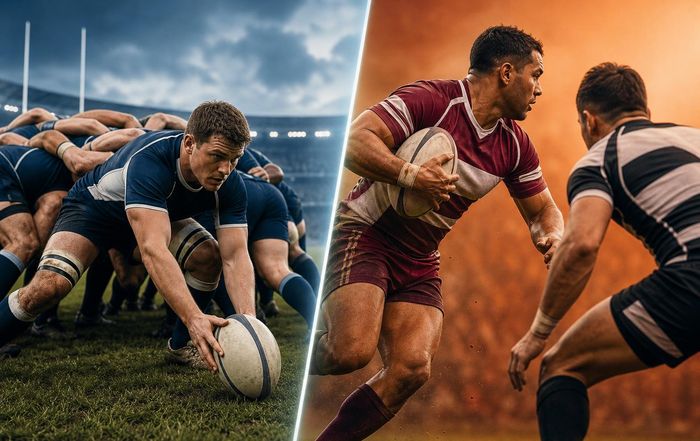
Rugby Union vs Rugby League: Key Rules, Differences, and What They Mean on the Field
Rugby union and rugby league share a common ancestor and plenty of surface similarities: an oval ball, heavy contact, and 15-a-side or 13-a-side players driving for the try line. Yet anyone who has watched both codes closely knows they feel like different sports in tempo, tactics, and culture. For athletes deciding which game to play, fans trying to understand what they are watching on TV, or coaches and trainers tailoring conditioning plans, understanding the key differences matters.
This top guide breaks down how the two codes diverge in laws, structure, strategy, and physical demands, and why those differences shape everything from fitness profiles to global popularity.
Origins and Global Footprint
Rugby's split into union and league dates back to 1895 in England, when northern clubs broke away from the Rugby Football Union over the issue of compensating working-class players for lost wages. The new body became the Northern Rugby Football Union, later rugby league, while rugby union remained strictly amateur until 1995.
Today, rugby union is governed globally by World Rugby and is played in more than 100 countries, with strongholds in nations such as New Zealand, South Africa, England, France, Ireland, and Argentina. The men's Rugby World Cup is one of the largest global sporting events, and union is also an Olympic sport through rugby sevens. World Rugby's global footprint and law book are accessible via world.rugby.
Rugby league, governed by the International Rugby League (IRL), has its deepest roots in parts of northern England and eastern Australia, but also has strong international programs in New Zealand, Papua New Guinea, Tonga, Samoa, and emerging nations across Europe and the Pacific. The IRL's governance and global competitions can be explored via irl.sport.
For readers tracking how different sports codes are evolving worldwide, both games intersect with broader sports business, media rights, and participation trends, but they occupy different cultural and commercial niches.
Team Size, Field, and Scoring: The Structural Basics
At a glance, the easiest way to tell the codes apart is the number of players and some field markings, but scoring values also differ and affect tactics.
In rugby union, each side fields 15 players: eight forwards and seven backs. The standard scoring system is 5 points for a try, 2 for a conversion, and 3 for penalties and drop goals. Matches usually run 80 minutes, split into two 40-minute halves, with limited substitutions (typically eight replacements in elite competitions, with specific rules on tactical versus injury substitutions). The laws and variations used in elite competitions such as the Rugby World Cup are grounded in World Rugby's regulations at world.rugby.
Rugby league uses 13 players per side: traditionally six forwards and seven backs. The scoring is slightly different: 4 points for a try, 2 for a conversion, 2 for a penalty goal, and 1 for a drop goal. While match length is also 80 minutes, league allows more interchanges (often up to eight in competitions like the NRL and Super League), which supports its faster, repeat-sprint style. Key competition regulations are aligned with the IRL and national bodies such as the NRL in Australia and Rugby Football League (RFL) in England, accessible via nrl.com and rfl.uk.com.
The playing area in both codes is similar in overall size (around 100m long plus in-goal areas, and up to 70m wide), but rugby league fields have distinctive 10-metre lines that are central to defensive positioning, while union fields emphasize the halfway, 22-metre, and 5-metre lines, which structure kicking and set-piece strategy. For athletes and coaches planning conditioning work around sport-specific demands, these structural details translate directly into how space is used and how frequently players accelerate, decelerate, and make contact, themes covered more broadly in our performance coverage.
Possession and Continuity: The Ruck vs the Tackle Count
The single biggest gameplay difference is how each code handles the tackle and possession. This shapes everything from attacking patterns to defensive workload.
In rugby union, when a ball carrier is tackled and goes to ground, both teams can contest for the ball in a ruck. Players must arrive on their feet, enter from the correct side, and attempt to drive the opposition off the ball. If the attacking team retains it, play continues; if the defenders win it, they can counterattack. There is no fixed limit to how many rucks can occur in a possession, and turnovers at the breakdown are a central tactical weapon. World Rugby's breakdown laws and safety initiatives around tackle height and head contact, detailed at world.rugby, have been heavily emphasized in recent years to reduce concussion risk.
Rugby league instead uses a tackle count system. After each completed tackle, the tackled player stands and performs a "play-the-ball" with the foot to a teammate behind. The attacking side has six tackles to advance and score. If they are tackled for a sixth time without scoring or kicking the ball away, possession automatically turns over to the opposition. This creates a predictable rhythm: run, get tackled, play-the-ball, repeat. The system rewards field position, structured attacking sets, and high completion rates, and makes turnovers at the ruck far less common than in union.
For spectators, these differences create distinct viewing experiences. Union can appear more chaotic but offers frequent momentum swings through breakdown turnovers, contested kicks, and penalties. League is cleaner and more linear, with fewer stoppages for scrums or penalties and a clearer sense of "sets" similar to American football downs. For players, the breakdown in union demands specific technical skills and strength endurance, while league emphasizes repeated high-intensity efforts and line speed, topics we regularly explore in training and fitness features.
Set Pieces: Scrums, Lineouts, and Restarts
Set pieces are another major point of divergence and a key reason forward play feels so different between the codes.
In rugby union, scrums are full contests for possession. Eight forwards from each team bind together and push against each other as the scrum-half feeds the ball in. Teams invest heavily in scrum technique, body position, and coordinated power, and scrum dominance can yield penalties, territory, and psychological advantage. Lineouts are also fully contested: when the ball goes into touch, forwards form jumping pods, with lifters hoisting jumpers to win or steal possession. These set pieces are central to union's identity and heavily influence player body types, especially in the front row and locks.
In rugby league, scrums still exist but are largely uncontested and mainly used as a way to restart play and create space for backline moves. There are no lineouts; when the ball goes into touch, possession is typically given to the non-offending team via a scrum or handover depending on the infringement. This reduces stoppage time and de-emphasizes specialized forward set-piece skills. Forwards in league still need power and collision resilience, but the absence of fully contested scrums and lineouts shifts the emphasis toward mobility and repeat efforts in open play.
Governing bodies such as World Rugby and the IRL have both adjusted scrum laws over time for safety, particularly around engagement sequences and neck and spine protection. Broader research into collision sports safety and concussion, from organizations like the World Health Organization at who.int and academic institutions such as University of Bath or University of Sydney (via bath.ac.uk and sydney.edu.au), continues to inform law tweaks in both codes.
Kicking and Tactical Shape
Kicking exists in both codes but carries different strategic weight and patterns, which changes how backlines are structured and how defenses respond.
In rugby union, teams use a wide variety of kicks: tactical touch-finders to gain territory, contestable box kicks from the scrum-half to pressure the catcher, cross-field kicks to exploit mismatches, and grubbers behind a rushing defense. Because union allows contesting possession in the air and at the breakdown, kicking can be a way to regain the ball as much as to clear it. Penalty kicks for goal from long distance are also common, and drop goals can be a decisive scoring option in tight matches, as seen in multiple Rugby World Cup knockouts.
Rugby league's kicking is more tightly integrated into the six-tackle structure. Teams often build pressure across the first four or five tackles, then kick on the fifth or sixth to gain territory or force a goal-line dropout. High bombs, cross-field kicks, and grubbers into the in-goal are used to create try-scoring chances or repeat sets. Because penalties for minor infringements are less likely to yield three-point shots at goal, league teams typically favor tries over penalty goals, which can encourage more expansive attacking play near the opposition line.
Media coverage from outlets such as bbc.com and theguardian.com frequently highlights how rule changes-like tweaks to the 50/22 kick in union or the "40/20" and "20/40" kicks in league-are used by smart half-backs to manipulate defensive backfields. For players transitioning between codes, adapting to these different kicking expectations is often one of the biggest tactical challenges.
Offside, Defensive Lines, and Contact Demands
Offside rules in both codes aim to preserve space for attack, but they are applied in different ways and directly influence defensive shape and physical load.
In rugby union, offside is most often defined relative to the last feet at the ruck or maul, or the kicker in open play. Defenders must retreat behind the offside line at each breakdown. Because rucks form frequently and the offside line often sits just a few metres from the ball, defenses compress around the breakdown and then fan out, creating a cat-and-mouse game between attacking distributors and defenders trying to maintain line integrity. Mauls and close-range pick-and-go sequences can involve repeated heavy collisions over short distances, demanding high strength and robustness from forwards and inside backs.
In rugby league, the defensive line typically must retreat 10 metres from the play-the-ball after each tackle. This creates a more clearly defined and more distant offside line, leading to structured "up and back" defensive systems. The result is repeated high-speed line speed and collision cycles across the 80 minutes. Sports science research, including work published via organizations like World Rugby and Rugby League World Cup partners, and summarized in outlets such as bmj.com or lww.com, has highlighted that league players can experience a very high number of high-intensity efforts and tackles per match, especially middle forwards.
For conditioning coaches, these patterns mean union players, particularly forwards, need to manage scrums, mauls, and short-burst collisions interspersed with longer running phases, while league players require exceptional repeat-sprint ability and resilience to frequent one-on-one or two-man tackles with minimal rest. These contrasts feed directly into sport-specific programs we discuss in health and fitness content.
Substitutions, Interchanges, and Match Tempo
How each code uses replacements also shapes tempo and fatigue profiles, which in turn affects tactics, player body types, and even career longevity.
Rugby union traditionally uses a limited number of replacements (commonly eight), with some returning only for blood or head injury assessments. Once a player is subbed tactically, they typically cannot return, except under specific front-row injury rules. This pushes coaches to think carefully about when to inject fresh legs and often means starters must manage their output to last 60-80 minutes. The last quarter of a union match can see fatigue open up space and lead to late tries, but it can also be dominated by set-piece specialists and powerful "finishers" off the bench.
Rugby league uses an interchange system, where a set number of interchanges (often eight) can be used to rotate players in and out during the match. This allows coaches to cycle middle forwards and manage workloads more aggressively, sustaining high tempo and physical intensity. Because of this, league forwards are often slightly leaner and more mobile than their union front-row counterparts, though there are exceptions at elite level.
Sports performance analyses from organizations like World Rugby, the NRL, and high-performance institutes such as the Australian Institute of Sport at ausport.gov.au have shown that interchange patterns can significantly affect collision counts, running metres, and late-game performance. For athletes considering crossover between codes, understanding how their role might change in terms of minutes played and substitution expectations is crucial.
Professional Structures, Leagues, and Player Pathways
Beyond the laws on the field, the professional ecosystems around union and league offer different opportunities and career paths.
Rugby union has major club competitions such as Top 14 in France, United Rugby Championship across several European nations and South Africa, Premiership Rugby in England, and Super Rugby in the southern hemisphere. Internationally, flagship tournaments include the Rugby World Cup, Six Nations, and The Rugby Championship. The sevens format is also highly visible through the HSBC SVNS circuit and the Olympic Games, regulated by World Rugby at world.rugby.
Rugby league's professional heartlands are the National Rugby League (NRL) in Australia and New Zealand and the Betfred Super League in the UK and France. The Rugby League World Cup and regional competitions such as the State of Origin series in Australia are major events. Governance and competition structures are led by the IRL, with details and development programs accessible via irl.sport.
Women's rugby has grown rapidly in both codes. World Rugby's WXV competition and the Women's Rugby World Cup have raised the profile of women's union, while the NRLW and Women's Super League have dramatically expanded professional opportunities in league. Broader global sports coverage from outlets such as espn.com and sky.com often highlights how investment in women's programs, media rights, and grassroots participation is reshaping both sports' demographics and fan bases.
For players, agents, and performance staff, the different calendars, international windows, and pay structures across these competitions influence decisions about which code to pursue. These choices intersect with wider business and world sport-economy trends.
Player Profiles and Fitness Demands
While there is overlap in athletic requirements, the two codes tend to favor slightly different profiles for certain positions, and that affects training priorities.
In rugby union, the diversity of roles is striking. Front-row forwards (props and hookers) often carry greater mass and prioritize scrummaging strength and maul power, while back-rowers blend power, tackling volume, and breakdown skills. Backs range from nimble scrum-halves and tactical fly-halves to powerful centres and pace-heavy wings. Union players typically need a blend of aerobic capacity for sustained play, anaerobic power for bursts, and positional skills such as lineout jumping or tactical kicking. Conditioning programs frequently integrate elements of strength, hypertrophy, repeated high-intensity intervals, and technical skill work, areas we explore regularly in training and performance analysis.
Rugby league players, especially in modern NRL and Super League teams, are often more homogenous in body type: powerful, lean, and highly conditioned for repeat sprints and frequent collisions. Middle forwards need exceptional resilience to tackle volume and carry loads, while edge forwards and backs must combine speed with defensive reads in structured systems. Because there are fewer stoppages for set pieces, league matches can impose very high continuous running demands, documented in sports science research accessible through platforms such as pubmed.ncbi.nlm.nih.gov and summarized by performance consultancies linked to elite clubs.
Athletes crossing between codes-like high-profile examples in Australia, New Zealand, and the UK-often require months of tailored conditioning and skill adaptation. Their experiences underscore that while the sports look similar, the detailed demands on the body and mind are distinct.
Culture, Fan Experience, and Identity
Beyond rules and tactics, union and league have different cultural histories and fan identities, which still shape how they are perceived and marketed.
Rugby union historically had strong ties to private schools and universities in some countries, though this has diversified significantly since professionalism in 1995. Its global reach and strong international test match culture give it a particular prestige in nations like New Zealand, South Africa, and England, where the national team is a major cultural symbol. Governing bodies and clubs increasingly promote inclusion and accessibility, aligning with broader culture and social conversations about class, race, and gender in sport.
Rugby league has deep working-class roots in northern England and parts of Australia. Its fan culture is often described as intensely local and community-based, with strong club loyalties and regional rivalries. Events like State of Origin in Australia are among the fiercest contests in world sport, blending regional identity, physical intensity, and media spectacle. Coverage from outlets such as foxsports.com.au and independent.co.uk frequently highlights league's appeal as a fast, hard-hitting, television-friendly product.
In many markets, the two codes coexist, sometimes competing for athletes, sponsors, and broadcast windows, but also learning from each other in areas like player welfare, technology adoption, and fan engagement. The use of video assistant referees (TMO in union, Bunker in league), GPS tracking, and data analytics reflects broader sports technology trends covered in technology and gaming crossovers, including rugby video games and virtual coaching tools.
Safety, Law Changes, and the Future of Both Codes
Both rugby union and rugby league are grappling with the long-term health implications of repeated head impacts and concussions. Legal actions by former players in the UK and elsewhere, along with growing medical evidence, have pushed governing bodies to tighten tackle laws, enhance head injury assessment protocols, and adjust training loads.
World Rugby has introduced or trialed lower legal tackle heights, stricter sanctions for direct head contact, and improved return-to-play protocols, detailed at world.rugby. Rugby league regulators, including the IRL and national bodies like the RFL and NRL, have also updated head contact rules and introduced independent doctors and stricter head injury assessments. Public health organizations such as the Centers for Disease Control and Prevention (CDC) at cdc.gov and research initiatives summarized by nih.gov provide broader context on concussion management and youth sport guidelines.
These changes inevitably affect how both games are coached and played, particularly at grassroots and youth levels. Coaches, parents, and athletes increasingly prioritize safe technique, appropriate age-grade contact rules, and evidence-based conditioning. For many, the choice between union and league may hinge as much on local club culture, coaching quality, and safety environment as on the specific rule set.
Choosing Between Rugby Union and Rugby League
For players, coaches, and fans, deciding which code to commit to-or how to follow both-depends on personal priorities.
Those drawn to complex set pieces, varied kicking strategies, and the drama of international test rugby may gravitate towards union. The diversity of body types and roles can make it attractive for athletes with very different physical profiles, from powerful front-rowers to elusive wings. Union's global reach also offers more international pathways in some regions, from national teams to sevens on the Olympic stage.
Those who prefer a faster, more linear spectacle with structured sets, frequent ball-in-play, and heavy defensive workloads may find league more compelling. Its simplified set-piece structure and focus on repeat efforts appeal to athletes who enjoy high-tempo collision sports and clear tactical patterns. In heartland regions, league's community clubs and professional competitions provide strong development pathways and loyal fan bases.
From a broader active-lifestyle perspective, both codes offer demanding, social, and rewarding ways to stay active, develop teamwork, and engage with a global sporting culture. For many modern athletes and fans, the best answer is not union or league, but understanding and appreciating what makes each unique-and how both contribute to the evolving landscape of contact sports worldwide.