

How Smart Insoles Really Measure Running Form and Foot Pressure
Smart insoles have moved quickly from niche gadget to serious training tool. For runners who care about performance, injury prevention, and data-driven feedback, they offer something watches and phones cannot: a direct window into what the feet are actually doing with every step. Understanding how they measure running form and foot pressure helps explain which metrics matter, why some systems disagree, and how to interpret the flood of numbers many apps now deliver.
What's Inside a Smart Insole?
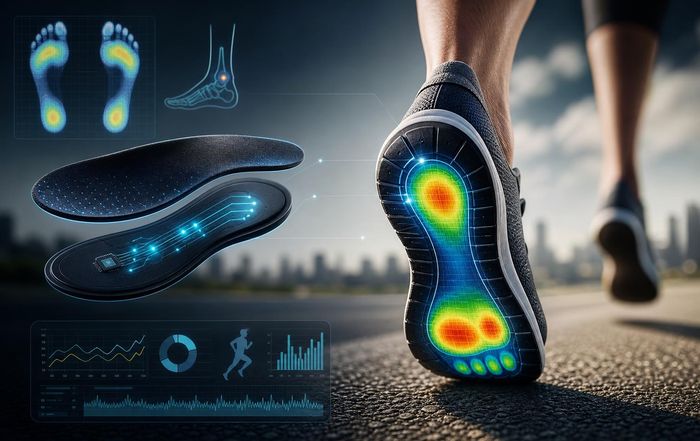
Although designs vary between brands, most smart insoles share a similar architecture: thin electronics embedded in a flexible insole that sits inside the shoe, paired with a small battery and wireless transmitter. The key components usually include pressure sensors, motion sensors, and a microcontroller that coordinates data collection and transmission.
At the heart of most systems is a network of pressure sensors, often built using force-sensitive resistors or capacitive elements. These sensors change electrical resistance or capacitance when compressed, allowing the insole to estimate the force under different parts of the foot. Brands such as NURVV, Digitsole, and Arion have popularized multi-sensor layouts, typically with clusters under the heel, midfoot, and forefoot. The more sensors an insole has, the more detailed the pressure map it can create, but this also increases complexity and cost. A microcontroller samples these sensors many times per second and sends the data via Bluetooth to a phone, watch, or dedicated pod.
Beyond pressure, many smart insoles embed inertial measurement units (IMUs), combining accelerometers and gyroscopes similar to those used in wearables from companies like Garmin and Apple. These sensors capture how the foot moves and rotates in three dimensions, providing raw data that algorithms can convert into running metrics. Some products add temperature sensors or basic step counters, but for serious running analysis the essential trio is pressure, acceleration, and angular velocity. Power management is another critical design element: compact lithium-ion or lithium-polymer batteries must run for an entire session while keeping the insole thin and flexible enough not to alter shoe fit or running mechanics.
How Pressure Sensors Capture Foot Loading
Foot pressure measurement begins with how the sensors are arranged. Most smart insoles do not cover the entire surface with sensors; instead, they strategically place a limited number at biomechanically important regions. Common zones include the rearfoot (medial and lateral heel), midfoot, and multiple forefoot locations under the first and fifth metatarsal heads and the big toe. This pattern reflects how ground reaction forces typically travel from initial contact to toe-off during walking and running. Clinical pressure platforms used in gait labs and research centers such as MIT and ETH Zurich often use hundreds or thousands of sensors, but consumer insoles must balance resolution with durability and battery life.
When the foot strikes the ground, each pressure sensor experiences a change in force. The insole's electronics convert this physical force into an electrical signal, then into digital data. By sampling at high frequency-often 50-200 Hz or more-the system can reconstruct a time series of pressure under each sensor throughout the stance phase. From this, the software estimates total load, how quickly force rises (loading rate), and how force shifts across the foot as the runner moves through contact, mid-stance, and push-off. This is particularly valuable for understanding impact peaks that might relate to overuse injuries, a topic frequently studied by groups referenced by organizations such as the American College of Sports Medicine at https://www.acsm.org/.
Because there are gaps between sensors, the insole must infer pressure in unsensed areas. This is usually done through interpolation and modeling based on typical force distributions and the runner's own data history. It is important to remember that smart insole pressure maps are estimates, not perfect ground-truth measurements. However, for many training decisions-such as detecting whether a runner is heavily heel striking, favoring one side, or loading the forefoot aggressively-the relative patterns are often more important than exact absolute forces. For athletes interested in how this relates to broader injury risk and foot health, connecting insole data with guidance on health and performance can be particularly useful.
Translating Pressure Into Running Form Metrics
Raw pressure values mean little without context. The real power of smart insoles lies in how they transform these readings into higher-level metrics that describe running form. One of the most widely used is footstrike pattern: whether a runner lands on the rearfoot, midfoot, or forefoot. By comparing which sensors first exceed a threshold at initial contact, and how long each region bears significant load, the insole can classify each step. This is similar in principle to assessments done in gait labs or sports medicine clinics, but now accessible on regular training runs.
Another important metric is center of pressure (COP) trajectory. By computing a weighted average of all active pressure sensors at each time point, the insole estimates the path the "average" force takes under the foot from touchdown to toe-off. A smooth, centrally located COP path may indicate stable mechanics, while large medial or lateral deviations can suggest pronation or supination patterns that might contribute to injury or shoe wear issues. While consumer devices often summarize this as "stability" or "foot roll," the underlying calculation is based on well-established biomechanics principles described in research accessed via organizations like PubMed at https://pubmed.ncbi.nlm.nih.gov/.
Pressure data also support contact time and cadence analysis. By detecting when total force rises above and falls below a threshold, the insole identifies the start and end of each stance phase, allowing precise measurement of ground contact time for each step. Counting these steps over time gives cadence, usually reported in steps per minute. While GPS watches already estimate cadence, insoles can link cadence directly to contact times and force patterns, giving a more complete picture of how changes in turnover affect loading. For runners working on efficiency, combining insole metrics with broader training content can help interpret whether a higher cadence is genuinely improving form or just increasing fatigue.
Motion Sensors: From Acceleration to Stride Mechanics
Pressure alone cannot describe how the leg and foot move through space. That is where IMUs come in. A typical IMU in a smart insole includes a three-axis accelerometer and a three-axis gyroscope. The accelerometer measures linear acceleration along three axes, while the gyroscope measures rotational velocity. By fusing these signals, the device can infer how the foot rotates and moves throughout each stride, even when GPS reception is poor, such as on treadmills or in urban canyons.
One of the most discussed metrics derived from IMUs is pronation or "foot roll." When the foot lands, it naturally rolls inward to help absorb shock. Excessive or very rapid pronation has long been debated as a risk factor for certain injuries, though evidence is mixed and nuanced, as highlighted by sports medicine bodies like the American Orthopaedic Society for Sports Medicine at https://www.sportsmed.org/. Smart insoles estimate pronation by tracking how the foot rotates around its long axis during stance, sometimes combining this with medial-lateral pressure shifts. The resulting numbers are usually reported as degrees of rotation or qualitative categories like "low," "moderate," or "high."
IMUs also enable measurement of metrics such as foot angle at contact, which describes whether the toes are pointing up or down when the foot hits the ground, and the degree of dorsiflexion at toe-off. Some systems use vertical acceleration patterns to infer impact severity or to estimate vertical oscillation of the runner's center of mass. When combined with pressure data, these motion signals help distinguish, for example, a soft, flexed-knee landing from a stiff, overstriding heel strike with similar peak forces but different loading rates. For runners interested in how technology shapes modern training, this crossover between biomechanics and wearables fits naturally alongside broader technology and sports coverage.
Measuring Foot Pressure Distribution and Asymmetry
One of the most practical applications of smart insole data is understanding how load is distributed not just within each foot but between left and right sides. Many runners unknowingly favor one leg, especially after an injury or when fatigue sets in. By summing the forces from all sensors on each insole, the system can report load symmetry as a percentage split-often aiming for values near 50/50 over time, with allowances for natural variation.
Within each foot, pressure distribution can reveal whether a runner loads the lateral forefoot heavily, spends a long time on the heel, or transfers weight quickly to the big toe at push-off. These patterns may help explain localized pain, callus formation, or shoe wear. For example, persistent high pressures under the second metatarsal head might correlate with metatarsalgia, while extremely high forefoot pressures in minimalist shoes could raise questions about training volume or surface choice. Organizations like Footwear Biomechanics Group and clinical bodies such as the American Podiatric Medical Association at https://www.apma.org/ have long emphasized the value of pressure mapping in clinical assessment; smart insoles essentially miniaturize aspects of that technology for everyday use.
However, not all asymmetry is problematic. Many elite and recreational runners show small left-right differences without issues. The key is context: sudden changes in symmetry, increasing imbalance with fatigue, or clear links between pressure hotspots and pain may warrant attention. For those exploring how lifestyle factors influence injury risk, combining insole insights with broader fitness and lifestyle guidance can support more informed decisions about training load and recovery.
How Accurate Are Smart Insoles Compared With Lab Systems?
Accuracy is one of the most important and most misunderstood aspects of smart insoles. High-end gait labs often use force plates embedded in the floor and motion-capture cameras tracking reflective markers. These systems, found in research institutions and professional performance centers, can measure ground reaction forces and joint angles with high precision, and organizations like World Athletics at https://worldathletics.org/ rely on such methods when validating shoe technologies and performance rules. Consumer smart insoles cannot match this level of accuracy, but they do not need to for most training purposes.
Studies comparing smart insoles with force plates and instrumented treadmills, frequently indexed through resources like Google Scholar at https://scholar.google.com/, generally find that insoles can estimate relative loading patterns, contact times, and step characteristics reasonably well, especially when calibrated for an individual user. Absolute force values may deviate, and high-intensity sprints or rapid direction changes can challenge sensor fidelity. Shoe type, lacing, and how tightly the insole fits also affect readings. Some brands offer calibration routines, asking users to stand still, walk, or perform simple movements to adjust baseline values.
Runners should interpret smart insole data as trend indicators rather than precise scientific measurements. If a device shows that a runner's left-right load balance shifts from 52/48 to 60/40 over several weeks, that relative change is probably meaningful, even if the exact percentages are off by a few points. Similarly, consistent observations-such as repeated high medial forefoot pressures during long runs-are more actionable than single-run spikes that may be due to sensor noise or unusual conditions. For those who need clinical-level assessment, consulting sports medicine professionals or biomechanics labs remains essential; smart insoles are best viewed as a bridge between lab-grade analysis and everyday training.
From Data Streams to Coaching Advice
Collecting data is only part of the story; how smart insoles present and interpret that data determines whether runners actually benefit. Most systems pair with smartphone apps that convert raw sensor streams into dashboards, trends, and coaching cues. Common features include real-time audio feedback, post-run summaries, and training plans that adapt based on form metrics rather than just pace or distance. Some platforms integrate with broader ecosystems from companies like Strava at https://www.strava.com/ or TrainingPeaks at https://www.trainingpeaks.com/, allowing athletes and coaches to view insole data alongside heart rate, GPS, and power.
Real-time guidance might alert a runner if their cadence drops below a target range, if impact forces spike beyond a chosen threshold, or if they begin to overstride. Post-run analysis often highlights sections of a route where form deteriorated-such as the final kilometers of a marathon-pace workout-encouraging targeted strength work or pacing adjustments. Some apps attempt to estimate injury risk scores by combining variables like high impact, long contact times, and asymmetry, though these models remain experimental and should be interpreted cautiously. Organizations like the National Institutes of Health at https://www.nih.gov/ and WHO at https://www.who.int/ continually emphasize that injury prevention is multifactorial, involving load management, recovery, footwear, strength, and individual health factors, not just a single wearable metric.
For coaches and sports scientists, smart insoles can enrich athlete monitoring by revealing how form changes with fatigue, surfaces, or shoe models. This can inform decisions about rotation between training and racing shoes, or about when to reduce volume after detecting unfavorable trends. For recreational runners, the value often lies in simple, clear messages: whether they are consistently landing too far in front of their body, spending excessive time on the ground, or placing disproportionate stress on one foot.
Practical Limits, Comfort, and Data Privacy
Despite their promise, smart insoles come with practical trade-offs. Comfort and durability are central concerns: the insole must be thin and flexible enough not to noticeably change shoe fit or feel, yet robust enough to survive thousands of steps, sweat, and repeated compression. Some runners find that added thickness or stiffness alters their preferred shoe geometry, especially in minimal or racing shoes. Battery life can also be a constraint; while many devices last for several hours, ultra-distance runners may need to manage charging carefully or accept partial data coverage.
Environmental conditions matter too. Very wet runs, extreme temperatures, or heavily muddy trails can challenge electronics, although most consumer products are designed with at least basic water resistance. Firmware updates sometimes improve algorithms or add metrics, but they can also change how existing numbers are calculated, making long-term trend comparisons tricky unless clearly documented by the manufacturer. Runners should pay attention to release notes and, when possible, note when algorithm changes occur so they do not misinterpret sudden shifts in their data.
Data privacy and ownership are increasingly important as more biometric information is collected. Smart insoles capture detailed movement patterns that, in aggregate, can reveal health status, injury history, or even identity. Users should review privacy policies and data-sharing settings carefully, especially when connecting devices to third-party platforms. Major consumer technology companies such as Apple at https://www.apple.com/ and Google at https://about.google/ have faced scrutiny over data practices in other domains, and similar concerns apply to sports wearables. Understanding who can access insole data, how long it is stored, and whether it may be used for research or marketing is part of responsible adoption of any connected training technology.
Using Smart Insoles Wisely in a Training Plan
For runners and coaches considering smart insoles, the most important step is deciding what questions they want to answer. Someone recovering from a unilateral injury might focus on load symmetry and contact times between legs. A performance-focused athlete might use insoles to compare form at different paces or in different shoes, or to monitor how fatigue affects mechanics late in long runs. Recreational runners may simply want reassurance that their form is reasonably balanced and that their footwear choices do not create extreme pressures in vulnerable areas.
Integrating insole data into training works best when combined with subjective feedback and other objective measures. If pressure maps show increasing forefoot load alongside reports of metatarsal discomfort, that is more actionable than either signal alone. Similarly, a rise in impact forces during a period of increased mileage may indicate that the body is struggling to adapt, suggesting a need for extra recovery or strength work. Key resources on world and news around sports science developments can help runners stay informed about evolving best practices in this space.
Ultimately, smart insoles are tools, not verdicts. They can highlight patterns, prompt questions, and guide experiments in technique or footwear, but they cannot by themselves guarantee performance gains or injury prevention. Runners who treat them as one input among many-alongside coaching, strength training, sleep, nutrition, and honest self-assessment-are most likely to benefit. As sensor technology and algorithms continue to improve, and as more data accumulate across diverse populations, these devices are likely to become even more capable. For now, understanding how they measure running form and foot pressure is the first step toward using them thoughtfully rather than being overwhelmed by numbers.