

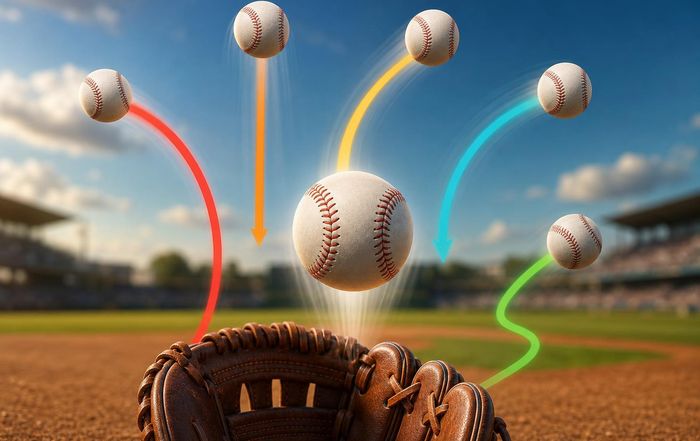
Baseball Pitch Types Explained for Beginners
For new fans and developing players, pitching can look like a blur of fastballs and mystery. The catcher flashes a sign, the pitcher nods, the ball pops the mitt-and commentators start talking about sliders, changeups, and cutters as if everyone automatically knows the difference. Understanding pitch types is one of the fastest ways to appreciate baseball strategy, whether you're watching Major League Baseball, playing youth ball, or simply trying to talk the same language as teammates and coaches. This guide breaks down the main pitches, how they move, why pitchers use them, and what batters look for, using clear explanations rather than insider jargon. By the end, you should be able to recognize the core pitch families, understand what makes them effective, and see how they fit into the wider world of training, performance, and modern analytics.
For people who are also active athletes, grasping pitch types can influence how you train your eyes, your swing, and even your arm-care routines. It connects naturally with other wild topics like training, performance, and even long-term health, because not all pitches stress the body in the same way. As baseball globalizes-from youth leagues in Europe to professional circuits in Asia and Latin America-this shared vocabulary around pitch types has become part of the sport's universal culture.
How pitches differ: speed, spin, movement, and intent
Every pitch is a combination of four basic elements: velocity, spin, movement, and intent. Velocity is the simplest to see on a broadcast radar gun, but it's only one piece of the puzzle. Spin rate and spin direction, which organizations like Major League Baseball and NCAA teams now track with advanced systems, control how the ball moves through the air. The way a pitcher grips the ball and releases it determines that spin, creating the signature rise-like effect of a high fastball, the sharp dive of a splitter, or the sweeping break of a slider. Movement can be vertical (up or down), horizontal (side to side), or a combination, and elite pitchers use all three dimensions.
Intent is what transforms raw physics into strategy. A fastball might be thrown to challenge a hitter in the strike zone, set up a breaking ball, or simply change the hitter's eye level from low to high. Off-speed pitches like changeups are designed to disrupt timing by mimicking fastball arm speed while arriving much slower. Breaking balls-sliders and curveballs especially-force hitters to track spin and trajectory, increasing the chance of a swing and miss or weak contact. Modern tracking tools used by MLB at mlb.com and amateur tools promoted by groups like USA Baseball at usabaseball.com help quantify these elements, but the underlying ideas remain accessible: every pitch is a different blend of speed, spin, movement, and purpose.
The fastball family: four-seam, two-seam, sinker, and cutter
Fastballs are the foundation of pitching. For beginners, it's helpful to think of fastballs as a family of related pitches rather than just one type. The classic four-seam fastball is typically the straightest and fastest pitch. The pitcher grips the ball across the horseshoe seams with index and middle fingers, applying backspin at release. That backspin interacts with air resistance to create what many call "ride" or "hop," making high four-seamers appear to stay up longer than hitters expect. In most professional leagues, four-seam fastballs sit anywhere from the high 80s to high 90s mph, though there is wide variation depending on age and level. Organizations like Driveline Baseball at drivelinebaseball.com and Rapsodo at rapsodo.com have popularized measuring spin rate and vertical movement on four-seamers to help pitchers maximize that "ride" effect.
The two-seam fastball and sinker are close cousins that prioritize movement over pure velocity. With a two-seam grip, the fingers align along the seams instead of across them, creating more arm-side run-meaning the ball moves toward the pitcher's throwing-arm side (in toward a right-handed hitter from a right-handed pitcher). A sinker is a variation where the pitcher emphasizes pronation (turning the hand slightly inward) at release, creating more downward movement that encourages ground balls. While some analysts now lump two-seamers and sinkers together, the practical takeaway for beginners is simple: these fastballs are usually a bit slower than the four-seam but move more, especially down and in or down and away depending on the matchup.
The cutter, or cut fastball, sits between a fastball and a slider. Thrown with fastball arm speed but a slightly off-center grip, it breaks just a few inches toward the pitcher's glove side, often late in its flight. This small but sharp movement can break bats and jam hitters, especially when thrown inside. Famous users like Mariano Rivera helped make the cutter a staple at the highest level. For developing pitchers, coaches often stress mastering a four-seam fastball first before layering in sinkers or cutters, since command of a primary fastball remains the basis of most pitching plans. For players interested in how fastball types affect training load and mechanics, exploring broader fitness and sports content can provide useful context.
Changeups: same arm speed, different timing
If the fastball is the foundation, the changeup is often the first true off-speed pitch taught to young pitchers because it's generally considered less stressful on the arm than many breaking balls. The defining trait of a changeup is that it is thrown with fastball-like arm speed but arrives 8-15 mph slower. That speed gap disrupts a hitter's timing, causing early swings that result in misses or weak contact. Many hitters are trained to "sit fastball," meaning they anticipate a fastball and adjust to other pitches. A well-executed changeup punishes that tendency by looking like a fastball out of the hand but floating or dropping just before reaching the plate.
There are multiple changeup grips-circle change, three-finger change, and vulcan change among them-but they all aim to reduce velocity and add movement without changing arm speed. The circle change, commonly taught in youth and amateur programs, involves forming a small circle or "OK" sign with the thumb and index finger on the side of the ball, while the other fingers apply pressure. This grip, combined with pronation at release, often creates arm-side fade and some downward movement. Educational materials from groups like Little League International at littleleague.org and USA Baseball emphasize the changeup as a safer way for young players to add variety before attempting more stressful breaking pitches.
From a hitter's perspective, recognizing the changeup early is challenging because the arm action mirrors the fastball. Experienced batters may look for subtle cues like grip glimpses, release height, or differences in ball rotation, but even professionals are frequently fooled. For developing pitchers, learning to trust the changeup-throwing it in fastball counts, to both right- and left-handed hitters-can be a major step forward. It also illustrates a broader performance principle that applies across sports: deception and timing can be just as powerful as raw speed, a theme that connects with wider performance and training discussions in other disciplines.
Breaking balls: slider, curveball, and slurve
Breaking balls are pitches that deviate sharply from a straight path due to topspin or sidespin. They are visually dramatic and often highlight-reel material, but they also carry more mechanical complexity and, at times, more injury risk if thrown incorrectly or too early in a young pitcher's development. The two most common breaking pitches are the slider and the curveball, with a hybrid known as the slurve somewhere in between. Organizations like the American Sports Medicine Institute at asmi.org and medical bodies such as the American Academy of Orthopaedic Surgeons at aaos.org have published guidance suggesting caution when introducing breaking balls to youth pitchers, emphasizing proper mechanics and pitch counts.
The slider is typically thrown harder than a curveball, often just a few mph slower than a pitcher's fastball, with sharp lateral and downward break toward the glove side. The grip places the fingers slightly off-center, and the pitcher imparts primarily sidespin, creating a tight spinning ball that appears to "slide" away from the hitter. Modern analytics, widely discussed on sites like FanGraphs at fangraphs.com and Baseball Savant via MLB, show that sliders are among the most effective swing-and-miss pitches in professional baseball, especially when tunneled off a similar-looking fastball trajectory. For beginners, the key idea is that sliders move late and diagonally, making them hard to square up when well located.
The curveball, by contrast, is usually slower and features more dramatic vertical drop. Traditional "12-6" curveballs (named for the movement on a clock face) break almost straight down from top to bottom. The pitcher uses a grip along the seams and pulls down with the fingers at release, creating topspin that fights the natural backspin of a fastball. This topspin causes the ball to dive as it approaches the plate. Some curveballs also sweep horizontally, producing a "1-7" or "2-8" break depending on handedness. When that horizontal component becomes more pronounced and velocity creeps closer to slider territory, the result is often called a slurve-a pitch with characteristics between a true curveball and a slider.
For young or new pitchers, the temptation is often to chase maximum break by "twisting" the arm or wrist aggressively, which can increase stress on the elbow. Medical and coaching organizations, including MLB's Pitch Smart initiative at mlb.com, encourage learning proper mechanics under qualified supervision and delaying heavy breaking-ball usage until the body is more mature. For fans, simply recognizing the visual differences-a tighter, harder diagonal break for sliders versus a slower, more looping drop for curveballs-can make watching games more engaging and help decode commentary from analysts and broadcasters.
Specialty and advanced pitches: splitter, forkball, knuckleball, and more
Beyond the core fastball, changeup, and breaking-ball families, pitchers sometimes employ specialty pitches that serve specific strategic roles or suit their unique mechanics. The splitter, or split-finger fastball, is one of the most prominent. The pitcher spreads the index and middle fingers wide along the sides of the ball, creating reduced backspin and increased downward movement. Thrown with fastball arm speed, the splitter typically drops sharply as it nears the plate, often inducing swings over the top or weak ground balls. In professional baseball, splitters have enjoyed waves of popularity, especially among pitchers who want a swing-and-miss pitch that moves vertically but doesn't require the heavy topspin mechanics of a traditional curveball.
The forkball is a related but less common pitch where the fingers are spread even wider, "forking" around the ball. It tends to be slower and can have more tumbling action, but it is generally considered more difficult to control and potentially more stressful on the fingers and forearm. Another famous specialty pitch is the knuckleball, which aims for minimal spin rather than controlled spin. By gripping the ball with the fingertips or knuckles and pushing it forward, the pitcher creates an unstable flight path where the ball flutters unpredictably due to small changes in air pressure. Because of its extreme unpredictability, the knuckleball can be very difficult to hit-but also hard to catch and command, which is why only a handful of pitchers in any era rely on it.
There are also variants like the screwball, which breaks in the opposite direction of a typical curveball for a given handedness, and newer labels such as "sweeper" for sliders with especially wide horizontal movement. As tracking data from systems like Hawk-Eye and TrackMan, used in professional and college baseball and discussed by technology firms like TrackMan at trackman.com, becomes more widespread, analysts have created finer categories based on movement profiles rather than traditional names. For beginners, the specific labels matter less than recognizing that pitchers may tailor pitches to their bodies, grips, and strategic needs. What unites these specialty pitches is that they all manipulate spin or lack of spin in unusual ways, trading ease of control for unique movement that can give hitters a different look.
How hitters recognize pitches: cues, timing, and "tunneling"
From the batter's box, identifying pitch types is a race against time. A pitched ball reaches home plate in roughly four-tenths of a second in professional baseball, meaning hitters have only a fraction of that to see, process, and decide whether to swing. They rely on a combination of cues: the pitcher's arm angle, release point, ball rotation, perceived speed, and the early part of the ball's trajectory. Many hitters talk about "picking up the spin," especially on breaking balls, where the seams may create a distinct red dot or blur. Others focus more on the pitcher's shoulder and hand path, training themselves to recognize small differences in mechanics that signal a particular pitch.
Modern analytics have introduced the concept of "pitch tunneling," where pitchers try to make different pitches look identical for as long as possible out of the hand before diverging late. When a four-seam fastball and a slider share the same release point and initial path, the hitter must commit earlier, increasing the chance of being fooled. Analysts at outlets like Baseball Prospectus at baseballprospectus.com and The Athletic at theathletic.com have explored how elite pitchers use tunneling to amplify the effectiveness of their arsenals. For beginners watching on TV or streaming, slow-motion replays and pitch-tracking graphics can help visualize how different pitches share or diverge from the same "tunnel."
Timing is the other crucial element. Hitters aren't just guessing pitch types; they're also anticipating locations and speeds based on the count, game situation, and pitcher tendencies. A hitter ahead in the count (for example, 2-0 or 3-1) might expect a fastball in the strike zone, while a pitcher may be more likely to throw a breaking ball when ahead, trying to get the hitter to chase. This cat-and-mouse game is part of what connects baseball to broader gaming and strategy cultures: beneath the physical skills lies a constant layer of prediction, adaptation, and counter-adjustment.
Pitch selection and game strategy: why throw what, and when?
Understanding the different pitch types sets the stage for a deeper question: how do pitchers and catchers decide which pitch to throw in a given moment? Traditionally, the catcher calls pitches based on the hitter's strengths and weaknesses, the pitcher's repertoire, the score, base runners, and the count. A hard-throwing pitcher might use the four-seam fastball up in the zone to get swings and misses, then drop in a breaking ball below the zone once hitters start gearing up for heat. A sinkerballer might live at the bottom of the strike zone, using sinkers and changeups to induce double-play grounders when runners are on base.
In recent years, data from tracking systems and scouting reports compiled by organizations like MLB and Baseball Reference at baseball-reference.com have increasingly influenced pitch selection. Teams analyze which pitch types perform best against specific hitters or in certain counts, and some pitchers now wear devices like PitchCom to receive signals from catchers without visible hand signs. For beginners, it's enough to know that pitch calling blends tradition, intuition, and analytics. A sequence might start with fastballs to establish the zone, then shift to sliders away once the hitter has shown a tendency to chase. Or a pitcher might "pitch backwards," opening with a breaking ball in a typical fastball count to disrupt expectations.
This strategic layer is one reason many fans find pitching duels compelling even when the score is low. Every pitch is a small decision in a larger plan, and knowing the basic pitch types helps decode that plan. For players, especially those interested in multi-sport or year-round lifestyle training, understanding pitch usage patterns can inform how they practice recognition, plate discipline, and situational hitting. For pitchers, video review and data feedback can reveal whether their slider is working best down and away or whether hitters are starting to sit on their changeup in certain counts.
Health, workload, and youth pitching: what beginners should know
While learning pitch types is fun and strategically rich, it also intersects with important health and workload questions, especially for younger players. Medical and sports organizations, including USA Baseball, MLB, and the American Orthopaedic Society for Sports Medicine at sportsmed.org, have highlighted rising rates of elbow and shoulder injuries among youth and adolescent pitchers. Overuse, year-round competition without adequate rest, and early specialization in high-stress pitches are frequently cited contributors. As a result, many leagues and national bodies now enforce pitch-count limits and required rest days based on age.
A common guideline from initiatives like Pitch Smart is to prioritize fastball and changeup development in younger age groups and delay heavy breaking-ball usage until the body is more physically mature. The reasoning is not that curveballs or sliders are inherently evil, but that they can be more demanding mechanically and may encourage poor habits if self-taught. Proper coaching, strength and mobility training, and adherence to rest recommendations are crucial. For families and coaches, integrating broader health and fitness habits-such as shoulder-strengthening programs, flexibility work, and monitoring for pain-can help reduce risk.
At higher levels, sports science and technology play a growing role in managing workloads. Teams use motion capture, wearable sensors, and pitch-tracking data to monitor stress and adjust training. Organizations like Major League Baseball and research-focused bodies such as the National Institutes of Health at nih.gov and the World Health Organization at who.int contribute broader research on injury patterns and youth sport participation that, while not baseball-specific in every case, inform best practices. For beginners, the essential takeaway is straightforward: learning and using different pitch types should always be paired with respect for the body's limits, honest communication about pain, and a long-term view of development rather than short-term results.
Bringing it all together: watching and playing with a sharper eye
Once you understand the major pitch categories-fastballs (four-seam, two-seam, sinker, cutter), off-speed pitches like the changeup, breaking balls such as sliders and curveballs, and a handful of specialty offerings-the game looks different. On a broadcast, you can start guessing pitch types before the graphic appears, watching for velocity, movement, and the catcher's target. At the ballpark, you might notice how a pitcher uses a high four-seam fastball to set up a low slider or how a well-timed changeup can neutralize a power hitter. For players, this knowledge can shape how you train your swing, what you look for in the box, and how you build your own pitch mix if you're on the mound.
Baseball's global growth means more leagues, more styles, and more experimentation with pitch design and strategy. Technology and analytics have added layers of measurement, but the core ideas remain accessible: pitches are tools, each with a distinct shape and purpose, and the duel between pitcher and hitter is a blend of physical skill, mental preparation, and tactical creativity. For those interested in exploring beyond the basics, related areas like sports, training, performance, fitness, and health provide a bigger context for how pitch types fit into the modern athlete's world. Whether you're just learning the game or deepening your understanding, recognizing and interpreting pitch types is one of the most rewarding steps in seeing baseball not just as a series of plays, but as an intricate, evolving craft.