

How to Build a Weekly Fitness Routine You'll Actually Stick With
Designing a weekly fitness routine is easy on paper and hard in real life. Work runs late, sleep runs short, motivation dips, and suddenly the "perfect" plan is abandoned by Wednesday. The most sustainable routines are rarely perfect; they are realistic, flexible, and built around a clear purpose. For active people who care about performance, health, and lifestyle, the challenge is less about finding exercises and more about designing a structure that fits their body, schedule, and priorities. That means understanding how much to do, how often to do it, and how to adapt when life inevitably gets in the way, rather than relying on short bursts of willpower or 30-day extremes.
A good starting point is to anchor your plan in evidence-based guidelines. Organizations like the World Health Organization and U.S. Centers for Disease Control and Prevention recommend most adults aim for at least 150-300 minutes of moderate-intensity aerobic activity per week, or 75-150 minutes of vigorous activity, plus two or more days of muscle-strengthening work involving major muscle groups. These benchmarks, available from sources such as WHO, CDC, and NHS, are broad ranges rather than strict rules. The art is in translating them into a weekly pattern you can maintain for months and years. That translation depends on your current fitness, injury history, sport or performance goals, and psychological tendencies around training. It also depends on your broader lifestyle, including sleep, stress, and nutrition, which are central themes across areas like health and lifestyle.
Start With Purpose, Not Exercises
Before choosing exercises, it helps to define what "success" looks like. For some, the primary goal is general health: better energy, lower disease risk, and the ability to keep up with work, family, and travel. For others, the focus is sport-specific performance, such as running a faster 10K, improving on-court agility, or building strength for recreational powerlifting. There are also aesthetic goals, such as increasing muscle definition or changing body composition, which often overlap with health and performance but are not identical. Clarifying your main goal shapes how you allocate time between cardio, strength training, mobility work, and recovery, and it prevents the common trap of chasing every trend simultaneously. That kind of clarity is also useful when navigating broader performance topics, such as those covered in training and performance.
A practical way to define purpose is to choose one primary goal and one or two secondary ones. For instance, you might prioritize "run a 5K without stopping" as the primary objective, with secondary goals of "reduce back pain" and "build basic upper-body strength." This hierarchy influences weekly structure: running sessions become non-negotiable anchors, while strength and mobility sessions support running rather than competing with it. Sports science research from institutions like the American College of Sports Medicine and National Strength and Conditioning Association, accessible via ACSM and NSCA, consistently shows that programs aligned with specific goals and capacities are more likely to be followed and to produce measurable results. A vague wish to "get fit" is harder to sustain than a concrete plan to "walk briskly for 30 minutes five days per week and do two full-body strength sessions."
Once goals are clear, it becomes easier to set realistic expectations about pace of progress. Weight loss, muscle gain, and performance improvements all occur on different timelines and respond differently to training volume and intensity. Many people abandon routines because they expect rapid, linear changes and become discouraged when progress slows or fluctuates. Understanding that plateaus are normal, and that adaptations in strength, endurance, and movement quality accumulate over months rather than days, helps keep the focus on the process. It also makes it easier to appreciate non-scale victories such as improved sleep, mood, and daily function, which are well documented in research summarized by organizations like the American Heart Association and Mayo Clinic.
Translate Guidelines Into a Weekly Structure
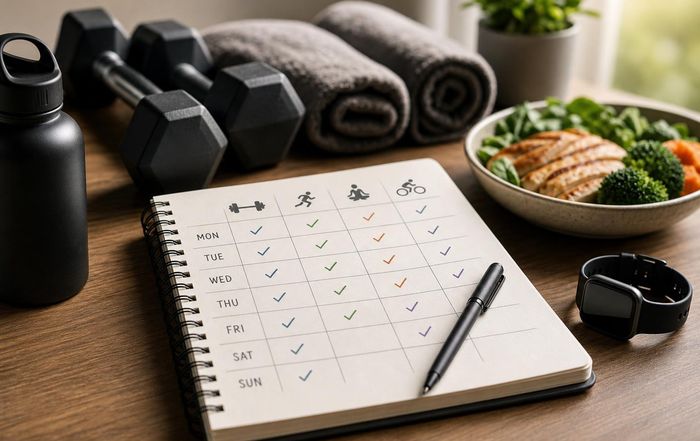
With a clear purpose, the next step is to turn broad recommendations into a weekly template. One of the most sustainable approaches is to think in terms of "movement slots" rather than rigid days. For example, you might define four strength slots, three cardio slots, and two mobility slots per week, then assign them to specific days based on your schedule. That approach allows some flexibility while still keeping volume consistent. For many adults balancing work and family, a realistic pattern might involve three to five days of structured training and two to four days of lighter activity such as walking, cycling to work, or playing with children. This blend supports both health and performance while leaving room for recovery.
A common, maintainable structure for general fitness is a three-day full-body strength plan combined with two or three moderate-intensity cardio sessions. For example, you might lift on Monday, Wednesday, and Friday, with 30-45 minutes of brisk walking, cycling, or easy running on Tuesday, Thursday, and one weekend day. This kind of arrangement meets the lower end of guideline recommendations and can be adjusted upward as fitness improves. Those with more demanding sport goals, such as competitive endurance or team sports, may need additional specific sessions, but the principle is the same: distribute workload across the week so that no single day becomes overwhelming. For ideas on how sport and culture intersect around these habits, readers can explore sports and culture coverage.
Another useful concept is intensity distribution. Research in endurance sports, highlighted by organizations such as World Athletics and USA Cycling, suggests that a large percentage of training should be low to moderate intensity, with a smaller portion at higher intensities. For general fitness, this might mean most cardio sessions are performed at a pace where you can still hold a conversation, with only one or two harder efforts per week. Similarly, strength training should be challenging but not maximal on every set; leaving one or two repetitions "in reserve" is often enough stimulus for progress without excessive fatigue. Over time, you can manipulate variables such as sets, reps, and rest periods to keep progressing without constantly changing exercises.
Finally, it helps to consider how training slots interact with your broader week. If work is consistently heavy on certain days, it may be more realistic to schedule shorter, lower-intensity sessions then and reserve longer or harder sessions for lighter days. Sleep timing, commute length, and family commitments all shape what is feasible. Many people find that morning sessions are easier to protect from unexpected demands, while others perform better later in the day. The right choice is the one you can repeat most consistently, not the one that looks most impressive on paper.
Choose Core Movements, Not Endless Variations
Exercise choice is often where routines become unnecessarily complicated. Social media and fitness apps present an endless stream of novel movements, but most sustainable programs are built around a relatively small set of basic patterns: squatting, hinging, pushing, pulling, and carrying, alongside locomotion such as walking, running, or cycling. These movements train large muscle groups, support everyday function, and can be scaled to different ability levels. For strength training, that might mean variations of squats, deadlifts or hip hinges, horizontal and vertical presses, rows or pull-ups, and loaded carries. For cardio, it might mean brisk walking, running, cycling, swimming, or machine-based options like rowing or elliptical training.
The key is to select exercises that fit your body and context. If deep barbell squats are uncomfortable or intimidating, goblet squats with a dumbbell may be more appropriate. If running aggravates your knees, cycling or swimming can provide similar cardiovascular benefits with less impact. Professional organizations such as ACE and NASM emphasize the importance of individualization, especially for beginners or those returning from injury. A routine you can maintain is one in which the main movements feel challenging but not painful, and where equipment requirements match what you have access to at home, outdoors, or in a gym. For those exploring gear, technology, or brand choices, the technology and brands sections can offer additional context.
Once you have a core set of movements, variation can be introduced through changes in load, tempo, or rep range rather than constantly switching exercises. This stability allows your nervous system to become more efficient at specific patterns, which often translates into faster strength gains and better movement quality. It also simplifies planning: instead of reinventing your program every week, you can repeat similar sessions with small progressions, such as adding a bit of weight, a set, or a few minutes of cardio. For people who enjoy novelty, accessories and finishers can provide variety without disrupting the main structure, but the backbone of the workout remains familiar.
Mobility and flexibility work should also be integrated around core patterns rather than treated as an afterthought. Simple routines focusing on hips, shoulders, thoracic spine, and ankles can be performed in 10-15 minutes, either at the start or end of sessions or on rest days. Resources from organizations like Yoga Alliance and Physiopedia highlight how targeted mobility can improve technique and reduce injury risk when combined with strength and cardio training. The goal is not extreme flexibility but comfortable, controlled ranges of motion that support the movements you perform most often.
Calibrate Volume, Intensity, and Recovery
The sustainability of a weekly routine depends heavily on balancing training stress with recovery capacity. Many plans fail because they start with an aggressive volume or intensity that outpaces muscles, tendons, and energy systems, leading to excessive soreness, fatigue, or minor injuries. A more effective approach is to start slightly below what you think you can handle and progress gradually. For beginners, that might mean two short strength sessions and two moderate cardio sessions per week, totaling perhaps 90-150 minutes of structured activity. As tolerance improves, sessions can be lengthened or additional days added, guided by how well you recover between workouts.
Monitoring subjective markers is often more practical than relying solely on numbers. Sleep quality, resting energy levels, mood, and appetite all provide clues about whether training load is appropriate. If you consistently feel run down, irritable, or unable to complete planned sessions, it may be a sign to reduce volume, intensity, or both. Sports medicine organizations like the American College of Sports Medicine and Cleveland Clinic note that overtraining symptoms can appear even in recreational athletes when life stress and inadequate sleep compound training stress. Building one lighter week into your monthly cycle-sometimes called a deload-can help consolidate gains and reduce the risk of burnout.
Intensity itself can be managed using simple tools such as the Rating of Perceived Exertion (RPE) scale or heart rate zones. For cardio, many people benefit from keeping most sessions at a comfortable pace, with only occasional higher-intensity intervals. For strength, working sets in the moderate rep range (for example, 6-12 repetitions) at a challenging but controllable effort is effective for building both strength and muscle in most non-specialist populations. High-intensity interval training and maximal lifting have their place, particularly for performance-focused individuals, but they are demanding and should be programmed sparingly. Integrating these elements into a broader weekly plan is where thoughtful training design becomes particularly important.
Recovery practices extend beyond simply taking days off. Sleep is arguably the most powerful recovery tool, with organizations like the National Sleep Foundation recommending 7-9 hours for most adults. Nutrition, hydration, and stress management also play significant roles in how your body responds to training. While detailed nutrition guidance is beyond the scope of a weekly routine, ensuring adequate protein intake, sufficient total calories, and a variety of micronutrient-rich foods can support adaptation and immune function. For readers interested in the broader health implications, the health section provides additional context around diet, disease prevention, and long-term wellbeing.
Design for Real Life: Time, Environment, and Motivation
Even the best-structured plan will fail if it does not fit your actual life. Time constraints, access to facilities, family responsibilities, and commuting patterns all shape what is realistic. One of the most effective strategies is to perform a candid audit of your week: identify consistent windows of 20-60 minutes that can be reserved for training, then design sessions to fit those windows rather than the other way around. For some, that might mean three 45-minute sessions before work; for others, it might mean shorter, more frequent sessions scattered between obligations. High-frequency micro-sessions-such as 10-15 minutes of mobility or bodyweight strength work-can accumulate meaningful volume when longer blocks are unavailable.
Environment also matters. If getting to a gym involves a long commute or unpredictable crowding, home-based routines using bodyweight, resistance bands, or minimal equipment may be more sustainable. Conversely, those who thrive on social energy or coaching may find that group classes, sports clubs, or small-group training provide accountability and enjoyment that solo training lacks. Studies summarized by organizations like the American Council on Exercise suggest that enjoyment and social support are strong predictors of long-term adherence. Choosing environments and formats you genuinely like-rather than those you think you "should" like-can be the difference between a routine that lasts a month and one that becomes part of your identity.
Motivation itself is often misunderstood. It tends to fluctuate, and relying on it alone is risky. A more reliable approach is to design systems and cues that make training the default choice. This can include preparing clothes and equipment the night before, scheduling workouts in a calendar like any other appointment, or pairing training with existing habits such as dropping children at school or finishing work. Habit research from institutions like Stanford University emphasizes the power of small, consistent actions tied to existing routines. Over time, the friction of starting a workout decreases, and the behavior becomes more automatic. For many, this shift from "I have to work out" to "this is what I do on these days" marks the point where a routine becomes truly maintainable.
It is also helpful to anticipate obstacles in advance. Travel, illness, busy seasons at work, and family emergencies are inevitable. Building "backup" versions of your workouts-shorter, simpler sessions that can be performed with minimal equipment-allows you to maintain momentum even when full sessions are not possible. For example, you might have a 15-minute bodyweight circuit or a brisk walk as a fallback on days when time or energy is low. Maintaining the habit of doing something, even if smaller than planned, can protect identity and confidence, making it easier to return to full training later.
Track, Adjust, and Evolve the Routine
No weekly fitness routine should remain static forever. As your body adapts and your circumstances change, the plan should evolve. Tracking is essential for this process. At minimum, recording the exercises performed, sets, reps, and approximate intensity provides data to guide progression. Some people also track sleep, mood, and soreness to identify patterns. Wearable devices and apps from companies like Garmin, Polar, and Apple, found at garmin.com, polar.com, and apple.com, can offer additional metrics such as heart rate variability and step counts, though these should be interpreted cautiously and in context. For those interested in how technology intersects with training and gaming, the gaming and technology sections explore some of these tools.
Adjustments should be made based on both progress and experience. If you are consistently meeting or exceeding your planned workload and recovering well, it may be appropriate to increase volume or intensity slightly, such as adding a set to key lifts or extending cardio sessions by five to ten minutes. Conversely, if performance is deteriorating or fatigue is mounting, reducing workload or adding an extra rest day may be wise. This process of autoregulation-responding to how you feel and perform rather than blindly following a plan-is common in high-level sport and useful for everyday athletes as well. It respects the reality that stress from work, relationships, and environment all affect how much training your body can productively handle.
Over longer timescales, such as three to six months, it can be helpful to step back and reassess goals. Maybe you have built a solid base of general fitness and now want to train for a specific event, such as a charity run, obstacle race, or recreational competition. Or perhaps you have discovered a new interest in a particular modality, such as strength sports, endurance cycling, or martial arts. Periodizing your year into phases that emphasize different qualities-base building, strength, power, or specific preparation-can keep training fresh and purposeful. Sports governing bodies and high-performance centers, such as UK Sport or Australian Institute of Sport, often publish general information on periodization concepts that can be adapted to recreational levels.
Finally, it is worth recognizing that life stages influence what is maintainable. The routine that worked in your early twenties may not be appropriate during years with young children or intense career demands, and it may change again later. Rather than viewing these transitions as failures, it can be more productive to see them as opportunities to redesign your weekly pattern to fit new realities. The constant is not a specific workout split but a commitment to regular movement, strength, and recovery practices that support health, performance, and enjoyment over decades. For those navigating broader lifestyle shifts, the lifestyle and world sections can provide additional context on how active living adapts across cultures and careers.
That is the end of the feature, but there is always another angle worth considering. Keep the conversation alive through curiosity and reflection. A weekly fitness routine you can maintain is less about perfect programming and more about alignment: alignment between goals and methods, between training load and recovery, and between routine and real life. By starting with clear purpose, structuring your week around manageable movement slots, choosing core movements that fit your body, calibrating volume and intensity, and continuously adjusting based on feedback, you can build a pattern of training that persists beyond short challenges or seasonal resolutions. Over time, that consistency becomes its own form of performance-one measured not just in times, loads, or body composition, but in the capacity to live, work, and play with energy and resilience.